What comes to mind when someone says “Champagne?” Maybe you think about a toast. Weddings. Celebrations. You might think of bottles that cost hundreds of dollars, the shimmery foil around the neck and the familiar pop of a swollen cork finally breaking free of the pressurized bottle.
Champagne is fancy, but it doesn’t have to be.
I love a celebration, but listen: Champagne is just a wine. Drink it at your cookout. Sip it as an aperitivo with some sheep’s cheese and salty Spanish almonds. Maybe open a bottle in the middle of the week to go with your BLTs or your fish sticks.
I promise, it goes with everything.

Making Champagne Special
If you want to make Champagne festive but you don’t have a particular occasion, here’s what you do: treat yourself to a bottle of single-grower Champagne.
What is that, you ask?
Champagnes are produced in one of three ways:
- By Houses, which are going to purchase a majority of the grapes needed to make their wine from various growers. Some Champagne houses are owned by corporations (think Moet) and others by families (think Billecart-Salmon).
- By Growers, who make Champagne grown only from their own grapes. These are made in very small batches, and they sell out quickly at wineries.
- By Cooperatives, who are growers that pool their resources to make and sell wines made from their members’ grapes.
I love single-grower Champagnes because they are so terroir-specific. In the wine, we taste variations among vintages and vineyards.

Rosé. That’s My Nickname.
I have no business listening to the gangsta rap, but I do anyway, and there’s a line in a Rick Ross song that I thought went: “Rosé…that’s my nickname.” Turns out he is actually saying “Rozay” as his nickname.
Whatever, I wouldn’t mind a nickname like rosé.
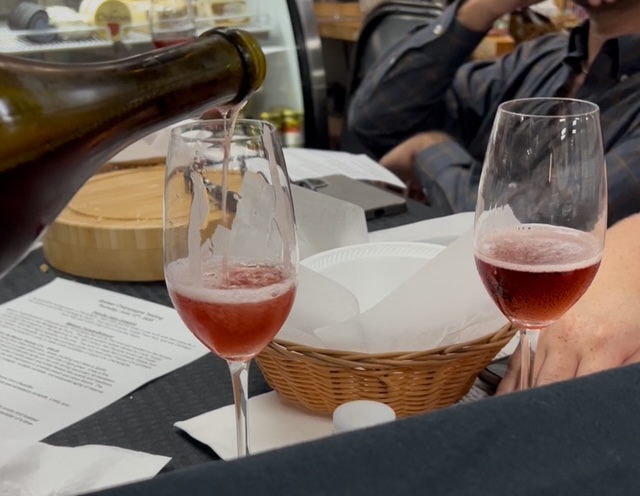
Back to the wine. I mention this lyric because I recently tasted five single-grower Champagnes from two growers, and my hands-down favorite was a rosé. It was the Jean Josselin ‘Auduce’ Rosé, made from 100 percent Pinot Noir. The red color was astonishing, and all you had to do was glance at it pouring into the glass to know that this was not a Provence rosé wine with an ethereal light, blush color. This was so rosy it wanted to be red. Strong, bubbling fizz in the glass. The aroma was fruit and the taste was all raspberries and red currants. It can be found for around $80 a bottle.
Tastings and Travels
A few weeks ago, I went to Miami for a class on South American Wine Regions. Yesterday morning, I attended a class online with Vins de Provence that focused on the region’s rosé wines, and I learned there are 32 different types of winds in Provence. Thirty-two types of winds. And all of them affect winemaking. Next summer, I’m hoping to travel to Bordeaux with one of the most brilliant wine educators I’ve ever met.
All of this to say, wine is an ongoing education. I go to tastings because I always learn something new. I sign up for classes because I usually have the opportunity to sip something I would never buy for myself.
We can drink better wine when we know how and where to find it. Go get a bottle of single-grower Champagne (look for a teensy tiny RM code on the back of the bottle to identify itself as single-grower). Drink it like it’s no big deal. That’s your assignment for the summer solstice.
Cheers,
Cari
Leave a Reply